
Many people use the terms marketing and selling interchangeably, but they are not the same. To distinguish between marketing and selling, it is important to understand that both concepts play different roles in business growth.
Marketing focuses on identifying customer needs and creating value, while selling mainly focuses on persuading customers to purchase products or services.
Understanding how to distinguish between marketing and selling helps businesses create better strategies, improve customer satisfaction, and increase long-term profitability.
In this blog, we will clearly explain how to distinguish between marketing and selling, including definitions, differences, examples, and their importance in business.
What Is Marketing?
Marketing is the process of identifying customer needs and creating strategies to satisfy those needs profitably.
Marketing includes activities such as:
- Market research
- Product development
- Branding
- Advertising
- Pricing
- Customer engagement
- Digital marketing
The main objective of marketing is to build long-term relationships with customers.
When businesses try to distinguish between marketing and selling, they often realize that marketing starts before the product is even created.
What Is Selling?
Selling is the process of convincing customers to buy products or services.
Selling mainly focuses on:
- Product promotion
- Persuasion
- Negotiation
- Closing sales
- Revenue generation
The goal of selling is to convert potential buyers into customers.
To properly distinguish between marketing and selling, remember that selling is only one part of the overall marketing process.
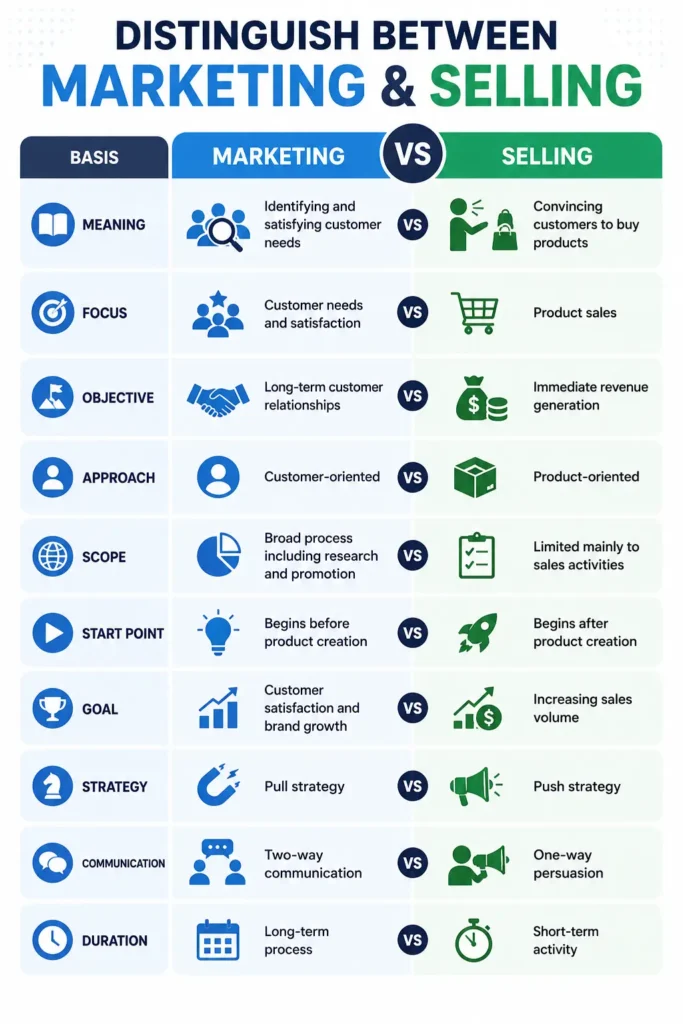
Distinguish Between Marketing and Selling
Basis | Marketing | Selling |
Meaning | Identifying and satisfying customer needs | Convincing customers to buy products |
Focus | Customer needs and satisfaction | Product sales |
Objective | Long-term customer relationships | Immediate revenue generation |
Approach | Customer-oriented | Product-oriented |
Scope | Broad process including research and promotion | Limited mainly to sales activities |
Start Point | Begins before product creation | Begins after product creation |
Goal | Customer satisfaction and brand growth | Increasing sales volume |
Strategy | Pull strategy | Push strategy |
Communication | Two-way communication | One-way persuasion |
Duration | Long-term process | Short-term activity |
Key Differences Between Marketing and Selling
1. Customer Focus vs Product Focus
One of the biggest ways to distinguish between marketing and selling is their focus.
Marketing focuses on customer needs.
Selling focuses on the product.
Marketing asks:
“What does the customer want?”
Selling asks:
“How can we sell this product?”
2. Long-Term vs Short-Term Goals
Marketing aims to build long-term customer relationships and brand loyalty.
Selling mainly focuses on short-term sales targets and revenue.
This is an important point when trying to distinguish between marketing and selling.
3. Scope of Activities
Marketing includes multiple activities such as:
Research
Advertising
Branding
Promotion
Customer support
Selling mainly focuses on the final transaction.
The broader scope helps clearly distinguish between marketing and selling.
4. Relationship Building
Marketing builds trust and long-term engagement.
Selling mainly focuses on completing a purchase.
Modern businesses understand that customer relationships are more valuable than one-time sales.
5. Strategy Difference
Marketing often uses a pull strategy by attracting customers through valuable content and branding.
Selling generally uses a push strategy by directly encouraging purchases.
This strategic difference helps businesses distinguish between marketing and selling effectively.
Conclusion
To properly distinguish between marketing and selling, it is important to understand that marketing focuses on customer needs and relationship building, while selling focuses on converting customers and generating revenue.
Marketing is a broad, long-term strategy that includes research, branding, promotion, and customer engagement.
Selling is a smaller but essential part of the business process that focuses on closing sales.
Both marketing and selling are important for business success. Marketing attracts and nurtures customers, while selling converts interest into revenue.
Businesses that successfully combine marketing and selling strategies can achieve sustainable growth and stronger customer relationships.
Contact PepMedia today: www.pepmedia.in | admin@pepmedia.in | +91 85919 07317